 Anselm's console · sample data
 Dominic's console · sample data
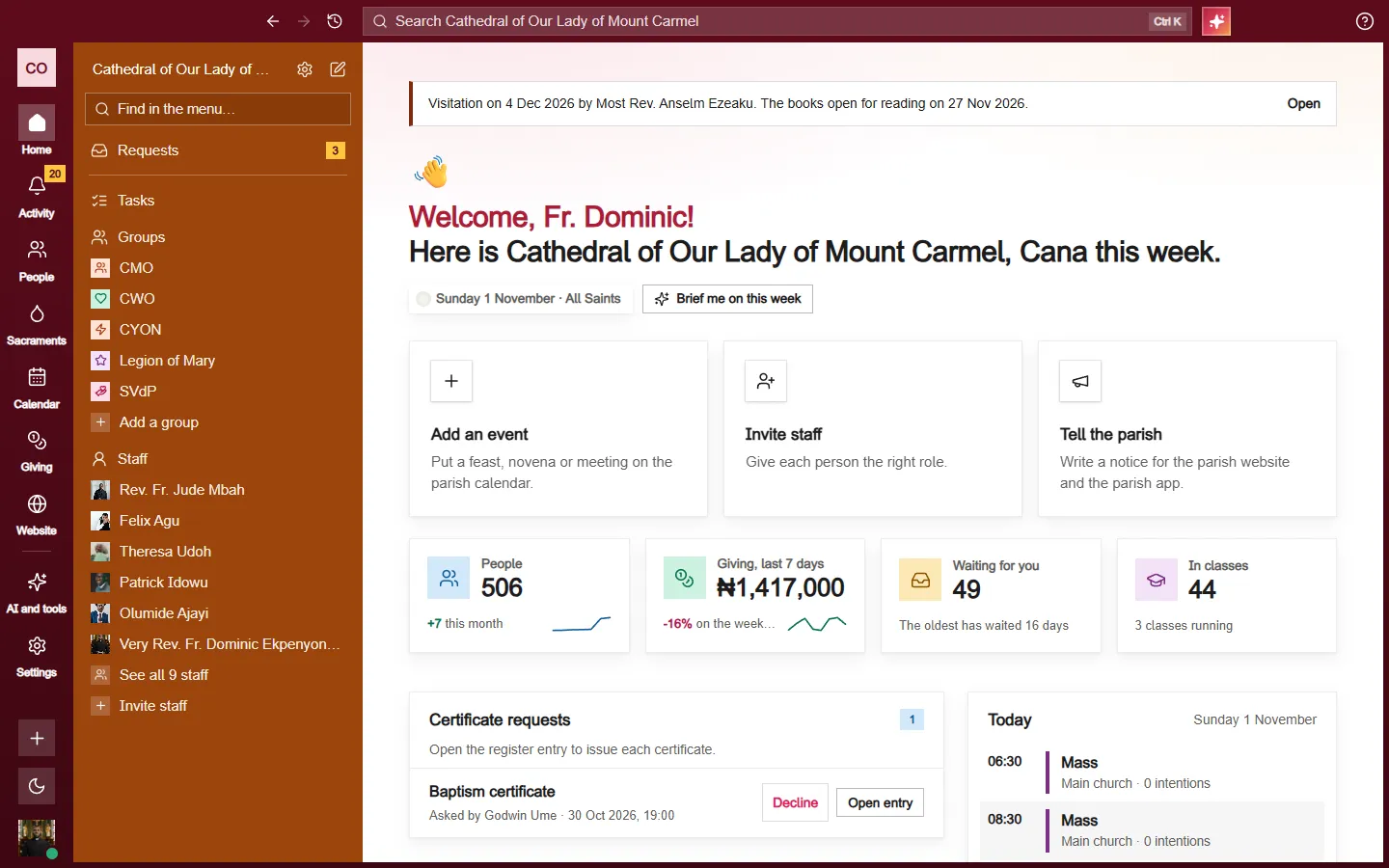
Groups come from your records
Nobody makes a group or adds people to it by hand. Each group reads its list from your records every time it opens.
- Parish staff: everyone with a staff role in the parish.
- Parish notices: everyone on your register who has an EcclesiaOne account.
- Societies: the society's members.
- Classes: the class's members, with the parents or guardians of its children.
- Ministries: everyone on a ministry list, such as the readers or the altar servers.
When someone joins a list, they are in its group at once. When they leave the list, they leave the group. New members see the whole history.
Open a group and choose Members to see who is in it, how (Moderator, Member or Guardian) and why they are in it.
Who moderates
- Parish staff, Parish notices and ministries: the parish priest and the parish administrator.
- Societies: the society's officers.
- Classes: the class's teachers.
A moderator can hide someone else's message: open the message's More menu and choose Hide from members. Members then see "A moderator hid this message". Moderators still see the words.
In Parish notices, only moderators post, and members reply in threads. In a class, the teachers post, and families reply in threads. In every other group, every member can post.
Young people in a group
- Children under 13 are not members. Their parents or guardians are in the group for them.
- Young people can write only when the group has two adult moderators, each with a current safeguarding clearance where your diocese asks for one. Until then they can read, and the group says so at the top.
- Every message an adult writes in a group with young people goes into the safeguarding log.
- Only moderators can mention a young person.
- No one can send a direct message to anyone under 18.
Writing in a group
- Open Groups and societies, then Messages, and choose the group. The New column shows unread messages.
- Write your message and send it.
- To name someone, type @ and choose them from the list. A mention by name always shows in their Activity, under Mentions.
Moderators can also use @everyone, at most three times a day in each group.
Add a reaction from the fixed list of twelve. To change or remove your own message, open its More menu and choose Edit or Delete. An edited message shows "(edited)".
Threads
Choose Reply in thread under a message to answer it beside the group. Threads are one level deep.
A reply tells the person who started the thread and the people who have replied in it. They see it in Activity. To put a copy of your reply in the group as well, tick Also send to the group.
What each group tells you
The bell at the top of each group sets what you hear about:
- Every message: where Parish notices and groups of 30 people or fewer start.
- Mentions and replies: where larger groups start.
- Nothing.
You can also mute a group for 1 hour or 12 hours, and choose Stop muting to end it early.
A mention by name reaches your Activity even with Nothing, or while the group is muted. An @everyone message reaches it only with Every message or Mentions and replies, and not while the group is muted.
Direct messages
Direct messages are conversations only the people in them can read: 2 to 8 people, all adults of the parish.
- Open Groups and societies, then Direct messages.
- Under New message, type a name. Each person shows Can write or Not open to you.
- Write the first message and send it.
The priests, the administrator, the parish secretary and the parish admin can write to any adult of the parish. Everyone else can write to them, or to people they share a group with. Parish notices does not count as a shared group.
The same people always share one conversation. On a person's page, Message starts a conversation with them. A direct message always shows in Activity, even when you have muted the conversation.
Reporting a message
You can report someone else's message in a group or a direct message. Open the message's More menu, choose Report message, write what is wrong, and choose Send report. Only the people who handle reports see what you wrote.
- In a group, the report goes to the group's moderators.
- In a direct message, it goes to the parish priest.
- A report about the parish priest or the parish administrator goes to the diocese's safeguarding officer.
The report shows in their Activity, under Mentions. When a moderator hides the message with Hide from members, the report leaves Activity. If the message is still showing a day later, the parish priest is told in Activity.
The parish office inbox
Parish office is where messages from parishioners to the office arrive. The priests, the administrator, the parish secretary and the parish admin see it.
A parishioner writes to the office from their own account. Each person has one conversation with the office, and it opens again whenever they write. Young people are not offered it.
- Open Groups and societies, then Parish office. Open lists the conversations still open; Closed lists the ones the staff have closed.
- Choose Claim to take a conversation, or Take over if someone else has it.
- Choose Reply to answer. The person sees your reply signed "Parish office (your name)".
- Choose Close when it is done. A new message from the person opens it again.
Nobody is told about a new conversation until someone claims it. After that, the person's messages reach whoever claimed it, in their Activity. If no one claims it and the person wrote last more than a day ago, the parish priest sees it in Activity. The row also shows Waiting over a day.
The office inbox is for people writing in. To start a conversation with someone yourself, use Direct messages. Messages from your website's contact form stay in Requests.